How to split a restaurant bill item by item
To split a restaurant bill item by item, list every dish with its price and quantity, assign each one to the people who ate it, then apply an agreed rule to shared dishes, tip and discounts. It is more work than dividing the final total, but it avoids making someone pay for food they did not order.
When splitting only the total is not fair
An equal split works when everyone ordered roughly the same thing. It becomes awkward when one person skipped drinks, two people shared a starter, someone ordered for a child, or a discount only applied to one dish. The question is not whether every receipt needs a full audit. It is whether the difference is large enough that the group would rather see the detail than argue about the total.
Agree the level of detail before opening a calculator. For a coffee and a pastry, a quick equal split may be friendlier. For a long dinner, a birthday meal or a group order with shared plates, use the receipt lines as the record of what happened.
A worked example
Four friends have a EUR 105.50 receipt. Three pizzas were ordered individually, the wine was shared by two people and everyone had one tiramisu. The item-by-item result is easier to check than asking everyone to remember their total after the meal.
| Receipt item | Assigned to | Each person pays | Line total |
|---|---|---|---|
| 3 Margherita pizzas | Ana, Luis, Maria | EUR 12.00 | EUR 36.00 |
| Caesar salad | Carlos | EUR 9.50 | EUR 9.50 |
| 2 bottles of wine | Ana, Carlos | EUR 18.00 | EUR 36.00 |
| 4 tiramisus | Everyone | EUR 6.00 | EUR 24.00 |
Final amounts: Ana pays EUR 36.00, Luis EUR 18.00, Maria EUR 18.00 and Carlos EUR 33.50. Together they add up to the EUR 105.50 receipt.
Use a clear rule for shared items
A shared item is not always an even split. If three people shared two starters, divide the starters among those three. If someone ate two portions while another had one, record those quantities. If a dish was for the whole table, include everyone. The important part is that the rule is visible before the final amounts are sent around.
Avoid forcing precision where it does not exist. A sauce, basket of bread or small service charge can be split evenly if the table agrees. Detailed allocation is useful when it resolves a meaningful difference, not when it creates a new argument over a few cents.
Handle tip and discount separately
Add the tip and discount only after the food and drink are assigned. A table-wide tip or discount is often shared by everyone. A promotion tied to one item usually stays with that item. State the rule in the group before calculating it, especially when a discount makes the final total differ from the sum of the menu prices.
Check the result before anyone pays
- Make sure each receipt line is included once and only once.
- Check that every shared dish has the right people and quantities.
- Confirm that individual amounts add up to the receipt total.
- Record who paid the restaurant bill, separately from who consumed each item.
That final distinction matters. The person who paid the bill may not be the person who ordered the most. Keeping payment and consumption separate turns a pile of receipt lines into a clear repayment plan.
When an app is useful
You can use this method with a receipt and a shared spreadsheet. An app becomes useful when the bill has many lines, people join later, or the group wants balances to remain available after dinner. VAKKA is one option: its free manual invoice flow lets you enter products, prices and quantities, then review the same assignments by person or by item. Its optional AI receipt scanner is a Plus feature, and scanned items should always be checked before saving.
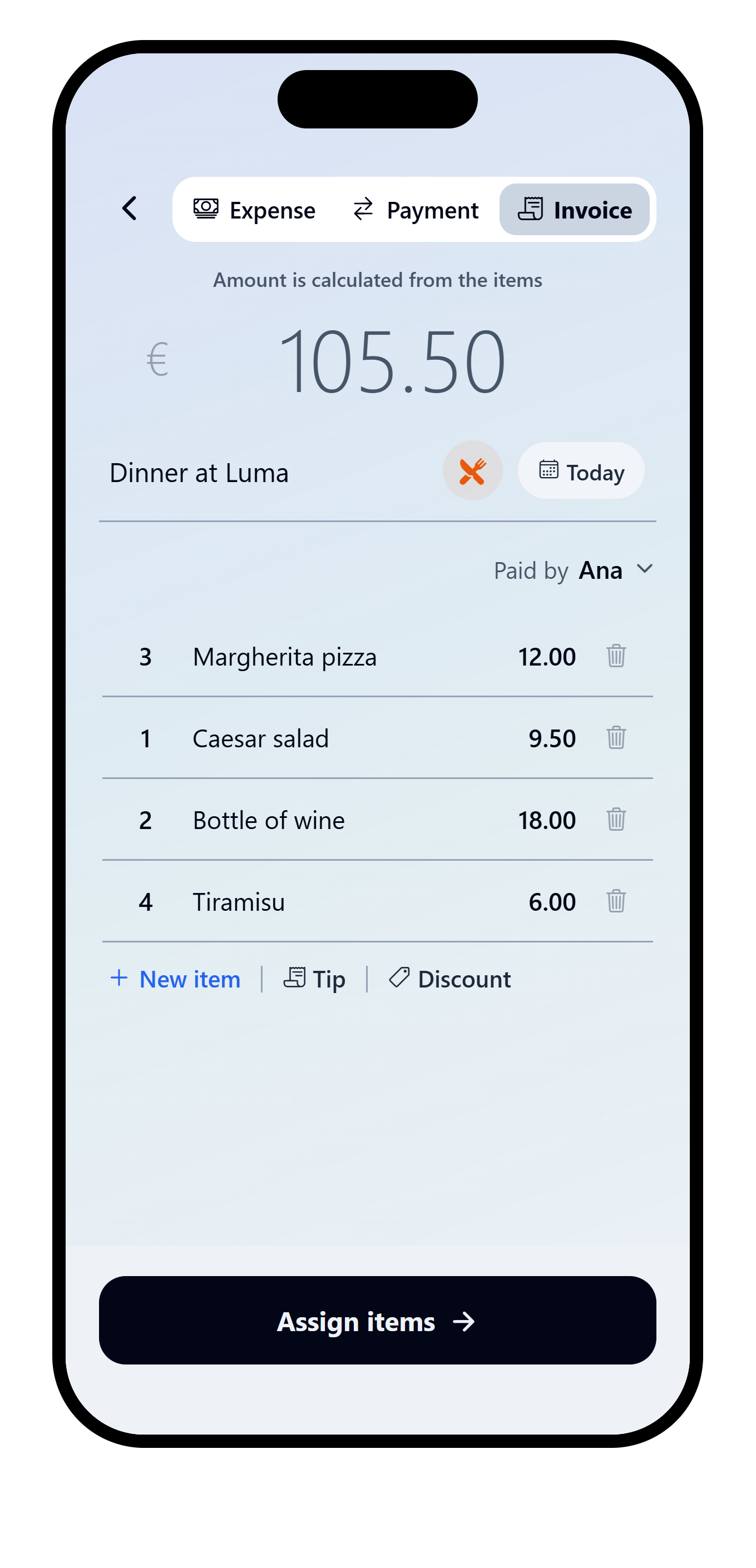
The step-by-step instructions are in the VAKKA Help guides for entering an invoice manually and reviewing assignments by person or item.
Keep the receipt clear from the start
Use VAKKA to record an itemized bill, review the split and keep the resulting balances together.
Download VAKKA